
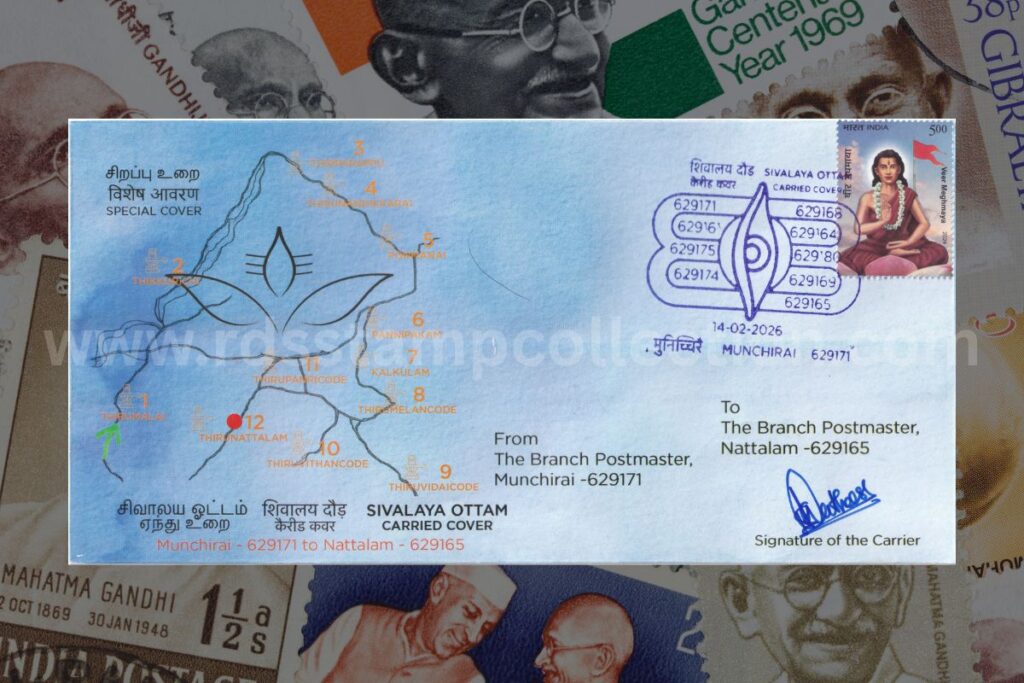
I recently came across a carried cover issued during the Sivalaya Ottam pilgrimage in 2026. This was the first time I heard the term Sivalaya Ottam. I first learned about it by reading the description printed on the back of the cover. What caught my attention immediately was the route map printed on the cover showing all twelve temples from Munchirai to Nattalam. Naturally, my curiosity pushed me to Google to learn more about this unusual pilgrimage.
After reading a bit more about it online, I discovered several interesting facts about this tradition. I thought it would be worth sharing them here.
Every year during Maha Shivaratri, thousands of devotees gather in southern Tamil Nadu for one of the most unusual temple pilgrimages in India, Sivalaya Ottam.
Most temple pilgrimages involve walking slowly from shrine to shrine. Sivalaya Ottam is completely different. Here devotees actually run between temples, covering nearly 100 km within about 24 hours.
And the special carried cover was released to commemorate this pilgrimage route itslef. The cover was carried from Munchirai to Thirunattalam on 14 February 2026, symbolically following the same route that devotees run every year during the pilgrimage. On 16 February, the cover was delivered to the Branch Postmaster at Nattalam (629165).
If you have never heard of Sivalaya Ottam before, it is quite different from most temple pilgrimages. The phrase Sivalaya Ottam literally means “running to Shiva temples.” The ritual takes place annually on the night of Maha Shivaratri when devotees begin a demanding spiritual run across the region.
Participants traditionally run barefoot from temple to temple, stopping briefly at each shrine to offer prayers before moving on to the next one. Many devotees chant “Govinda, Gopala” throughout the journey, reflecting a spiritual theme that emphasizes the unity of Shiva and Vishnu traditions.
The pilgrimage covers twelve temples, collectively known as the Sivalaya Ottam temples, forming a sacred route across the western part of Kanyakumari district.
The 12 temples on the Sivalaya Ottam route are:
- Thirumalai (starting temple)
- Thikkurichy
- Thirparappu
- Thirunandikkarai
- Ponmanai
- Pannippagam / Kumarapuram
- Kalkulam
- Thirumelancode
- Thiruvidaicode
- Thiruvithancode
- Thirupanricode
- Thirunattalam (final temple)
Each temple has its own historical and spiritual importance. So completing the pilgrimage is considered a powerful act of devotion.
Legend from Mahabharat
Like many ancient temple traditions in India, Sivalaya Ottam is associated with a fascinating legend from the Mahabharata.
According to tradition, Bhima was once assigned a difficult task that required obtaining milk from a mystical being named Vyagrapada, a fierce devotee of Shiva.
Before beginning his journey, Krishna gave Bhima twelve Shiva lingams and advised him to chant the names of Vishnu while approaching the sage.
Whenever the sage heard the chant, he became angry and chased Bhima. During the chase Bhima dropped one of the lingams on the ground. Each time this happened, a Shiva shrine appeared at that location. The sage stopped to worship the newly appeared lingam, allowing Bhima to escape temporarily.
This sequence repeated until twelve lingams had been dropped. These locations eventually became the twelve temples of the Sivalaya Ottam pilgrimage route.
The story also carries an important philosophical message — the essential unity of Shiva and Vishnu traditions.
The Sivalaya Ottam Carried Cover
In 2026, the Department of Posts, Tamil Nadu Circle released a special carried cover commemorating the Sivalaya Ottam pilgrimage.
The cover features:
- A map of the Sivalaya Ottam temple route
- The sequence of all 12 temples visited during the run
- Postal details identifying the pilgrimage path
- A special carried cover marking and cancellation
The cover was officially carried from Munchirai (629171) on 14-02-2026, symbolizing the beginning and delivered to the the Branch Postmaster, Nattalam (629165) marking completion of the pilgrimage.

The cancellation on the cover clearly marks Munchirai, the starting location of the sacred route. And the reverse side contains the delivery cancellation at Nattalam and a brief description about the Sivalaya Ottam.
What makes this cover particularly interesting for collectors is the printed route map showing all twelve temples. It visually explains the entire pilgrimage in a single design.
Final Thoughts
The story of Sivalaya Ottam is not just about a religious run between temples. It represents a deep cultural tradition that blends mythology, devotion, endurance, and community participation.
The Sivalaya Ottam carried cover beautifully captures this tradition in philatelic form. For collectors, covers like this are fascinating because they connect postal history with real cultural traditions.
For collectors, it is more than just a cover. It is a small but meaningful document linking faith, history, and philately.