
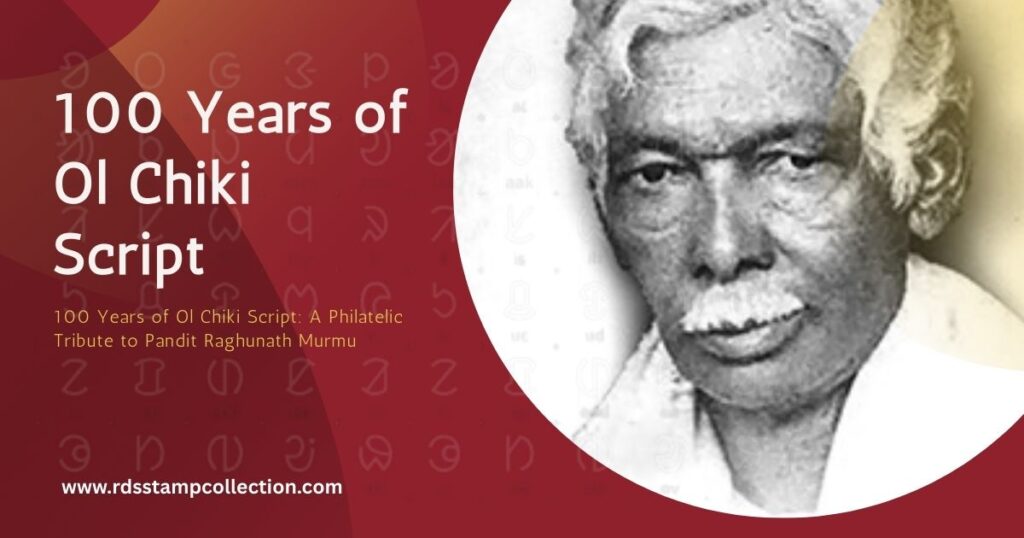
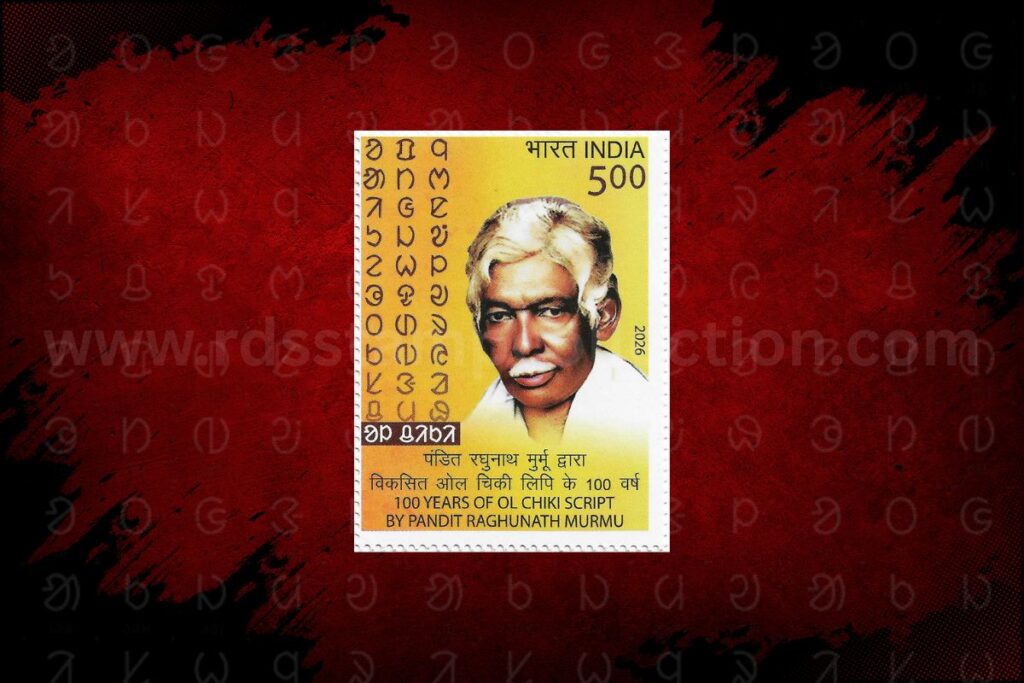
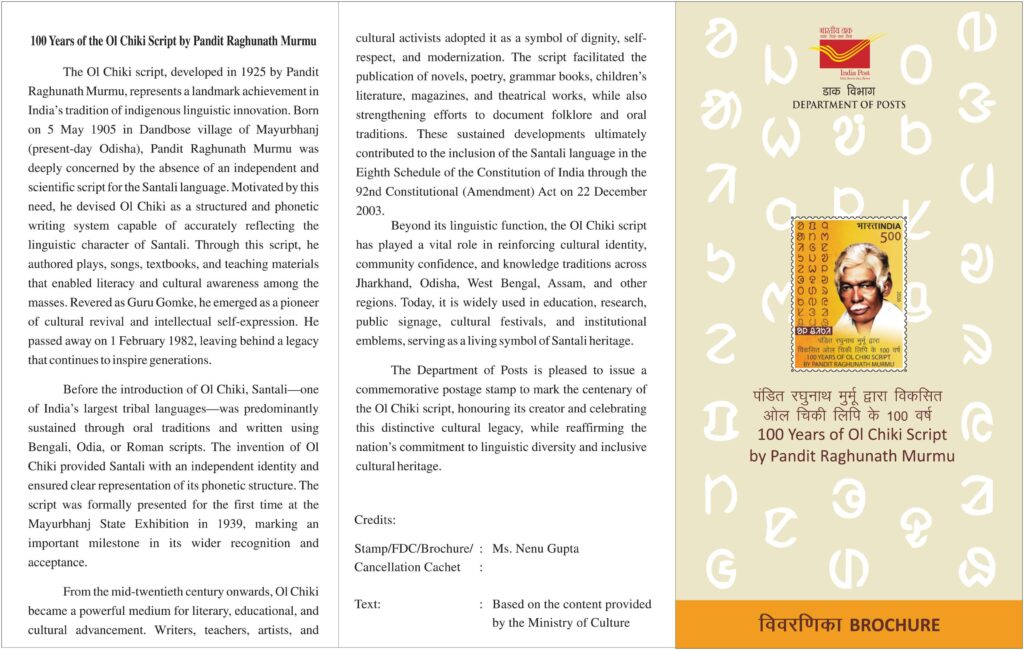
The issuance of a commemorative postage stamp marking 100 years of the Ol Chiki script celebrates a landmark in India’s linguistic and cultural history. Developed in 1925 by Pandit Raghunath Murmu, Ol Chiki provided the Santali language with an independent, scientific, and phonetic writing system. This philatelic release honours both the script and its creator while reaffirming the nation’s commitment to linguistic diversity and inclusive cultural heritage.
The Birth of Ol Chiki
The Ol Chiki script was devised in 1925 by Pandit Raghunath Murmu, who was born on 5 May 1905 in Dandbose village of Mayurbhanj (present-day Odisha). He was deeply concerned about the absence of an independent and scientific script for Santali, one of India’s largest tribal languages.
Motivated by this need, he created Ol Chiki as a structured and phonetic writing system capable of accurately reflecting the linguistic character of Santali. Through this script, he authored plays, songs, textbooks, and teaching materials that enabled literacy and cultural awareness among the masses.
Revered as Guru Gomke, he emerged as a pioneer of cultural revival and intellectual self-expression. He passed away on 1 February 1982, leaving behind a legacy that continues to inspire generations.
Santali Before Ol Chiki
Before the introduction of Ol Chiki, Santali was:
- Predominantly sustained through oral traditions
- Written using Bengali, Odia, or Roman scripts
The invention of Ol Chiki:
- Provided Santali with an independent identity
- Ensured clear representation of its phonetic structure
The script was formally presented for the first time at the Mayurbhanj State Exhibition in 1939, marking an important milestone in its wider recognition and acceptance.
A Medium for Literary and Cultural Advancement
From the mid-twentieth century onwards, Ol Chiki became a powerful medium for:
- Literary development
- Educational growth
- Cultural advancement
Writers, teachers, artists, and cultural activists adopted it as a symbol of:
- Dignity
- Self-respect
- Modernization
It enabled the publication of:
- Novels
- Poetry
- Grammar books
- Children’s literature
- Magazines
- Theatrical works
It also strengthened efforts to document folklore and oral traditions.
These sustained developments contributed to the inclusion of the Santali language in the Eighth Schedule of the Constitution of India through the 92nd Constitutional (Amendment) Act on 22 December 2003.
Cultural and Contemporary Relevance
Beyond its linguistic role, the Ol Chiki script has played a vital role in:
- Reinforcing cultural identity
- Building community confidence
- Preserving knowledge traditions
It is widely used across:
- Jharkhand
- Odisha
- West Bengal
- Assam
- Other regions
Today, it appears in:
- Education and research
- Public signage
- Cultural festivals
- Institutional emblems
It continues to serve as a living symbol of Santali heritage.
Pandit Raghunath Murmu: Life and Achievements
Pandit Raghunath Murmu is remembered as the creator of the Ol Chiki script and a central figure in the cultural and intellectual awakening of the Santali community.
Key facts and contributions:
- Born: 5 May 1905, Dandbose village, Mayurbhanj
- Developed the Ol Chiki script in 1925
- Created a scientific and phonetic writing system for Santali
- Authored:
- Plays
- Songs
- Textbooks
- Teaching materials
- Enabled literacy and cultural awareness among the masses
- Revered as Guru Gomke
- Pioneer of cultural revival and intellectual self-expression
- Passed away on 1 February 1982
His work gave Santali speakers:
- A script of their own
- A literary foundation
- A medium for education and knowledge transmission
His legacy continues to inspire generations.
The Philatelic Issue
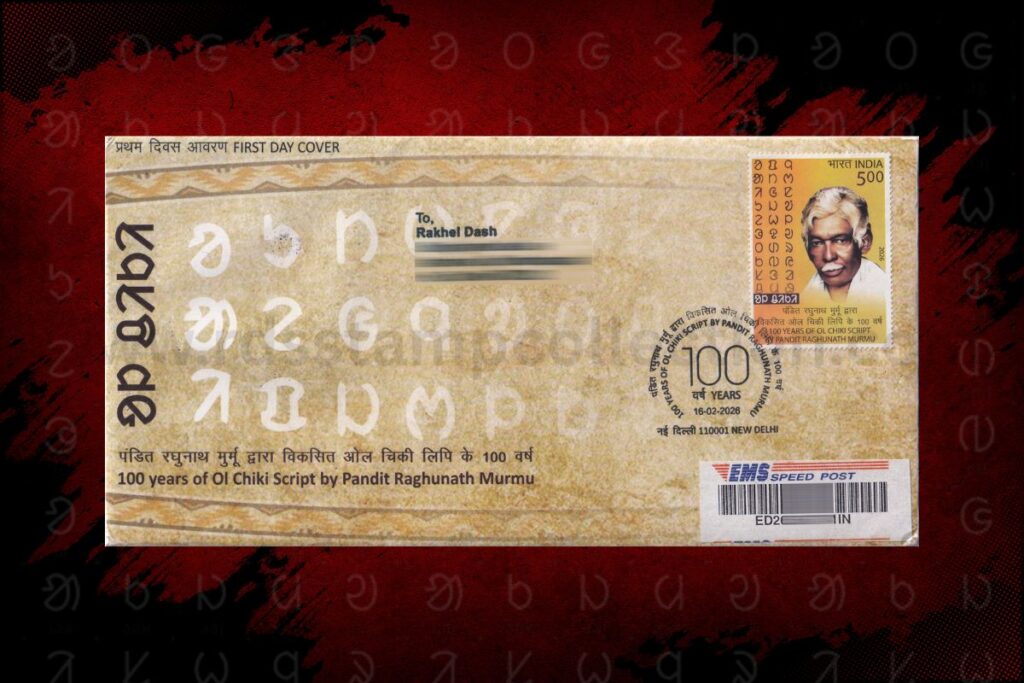
To mark the centenary of the Ol Chiki script, the Department of Posts issued a commemorative postage stamp of denomination Rs. 5.00 honouring:
- The creator of the script
- The cultural legacy of Ol Chiki
- India’s linguistic diversity
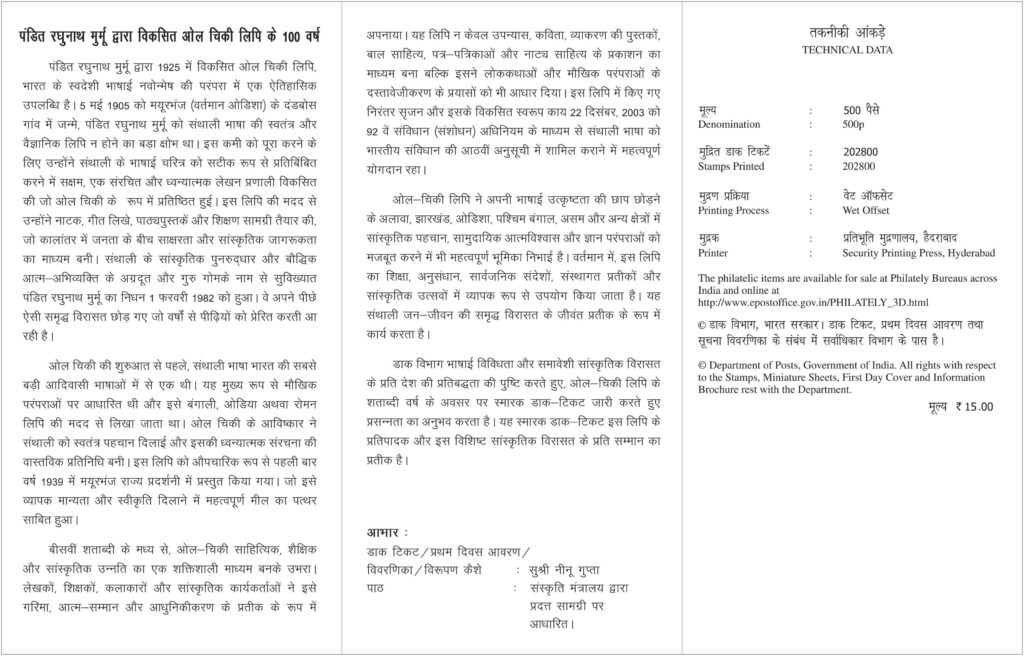
Credits:
- Stamp / FDC / Brochure: Ms. Nenu Gupta
- Text: Based on content provided by the Ministry of Culture
Conclusion
The centenary of the Ol Chiki script is not only a linguistic milestone but also a celebration of identity, knowledge, and cultural resilience. Through this commemorative stamp, philately once again becomes a medium for documenting and honouring transformative moments in India’s heritage.
For collectors, this issue represents a significant confluence of language, culture, history, and community pride, making it an essential addition to thematic and modern Indian philatelic collections.
Congrats for giving a detail study for the philatelist regarding a unsong heroes of Odisha