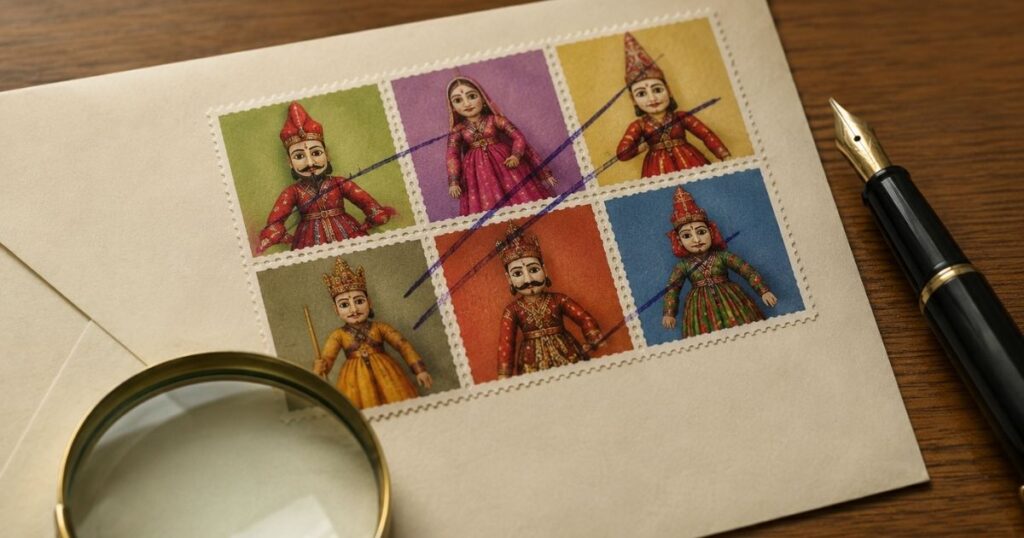
Receiving mail is still a special feeling for a philatelist.
In a time when most messages arrive through screens, a real envelope carries something different. It carries effort. It carries patience. And when beautiful postage stamps are used on it, the cover becomes more than just mail. It becomes a small collectible memory.
Recently, I received a mail from Hyderabad from a fellow philatelist. As always, I was happy to receive it. But when I looked closely, my excitement faded. The beautiful stamps used for postage were cancelled abruptly with a pen.
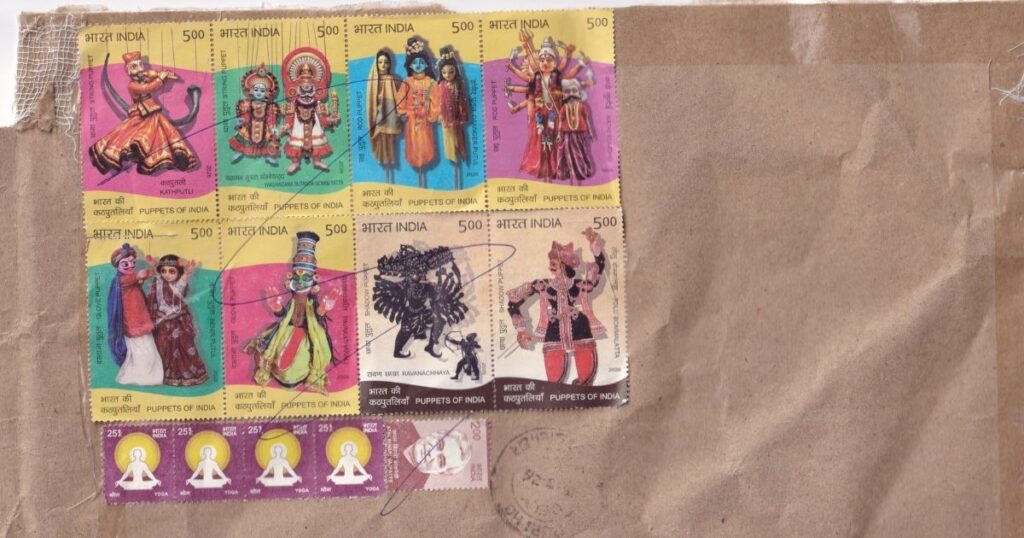
And not just one stamp.
The complete recently released Puppets of India set used on the mail was pen cancelled.
For any normal receiver, this may not matter. The letter reached safely. The postage was paid. The purpose of mail was served.
But for a philatelist, this hurts.
The Pain Behind a Pen-Cancelled Stamp
Usually, most of the mails I receive are cancelled with proper round date postmarks. These postmarks show the date and place of booking or processing. They add postal history to the cover. They make the item more meaningful.
A proper date cancellation tells a story.
It shows where the mail started. It records the date of postal journey. It links the stamp with actual postal use. For collectors, this is important.
But a pen cancellation destroys that charm.
A beautiful stamp, carefully selected for postage, suddenly looks like it has been crossed out in a hurry. The design is disturbed. The postal identity is missing. The collector value is reduced. Most importantly, the emotional value also suffers.
When I saw the complete Puppets of India set marked by pen, it immediately reminded me of similar experiences shared by many philatelists on different social media platforms. This is not an isolated issue. Many collectors across India and even outside India have faced the same problem.
So I thought of writing this post. Not as a complaint against any individual. But as a collector’s note. And as a small reminder that stamps on mail are not just pieces of paper.
They are miniature artworks. They are postal documents. They deserve proper cancellation.
Why Is Pen Cancellation Done?
To understand the issue fairly, we should also understand why pen cancellation happens.
The main purpose of cancelling a postage stamp is simple. Once the stamp is used for postage, it must not be reused. A cancellation mark prevents misuse or reuse of the same stamp.
In an ideal situation, this cancellation should be done using a proper date postmark, machine cancellation, or other authorised postal cancellation device.
But in practice, pen cancellation may happen for several reasons.
Sometimes the counter staff may be busy and quickly mark the stamps with pen. Sometimes the date stamp may not be available at that counter. In some cases, the article may move to the despatch section without proper cancellation, and someone may later mark the stamps with pen to prevent reuse. At times, staff may not fully understand the philatelic importance of clean postmarks. For ordinary mail, their priority is delivery and prevention of reuse. The aesthetic and collectible value of the stamp may not be considered.
This is where the problem begins.
From a postal operation point of view, a pen mark may seem like a quick solution. But from a philatelic point of view, it is a poor practice. It damages the stamp. It removes the chance of getting a proper date and place mark. It weakens the postal-history value of the cover.
This is exactly why awareness is needed.
India Post and the 2019 Circular
This issue has already been noticed at the official level.
The Assistant Director General (Philately), Department of Posts, Ministry of Communication, issued a circular dated 30-10-2019 asking postal offices to desist from inappropriate cancellation of postage stamps on mail.
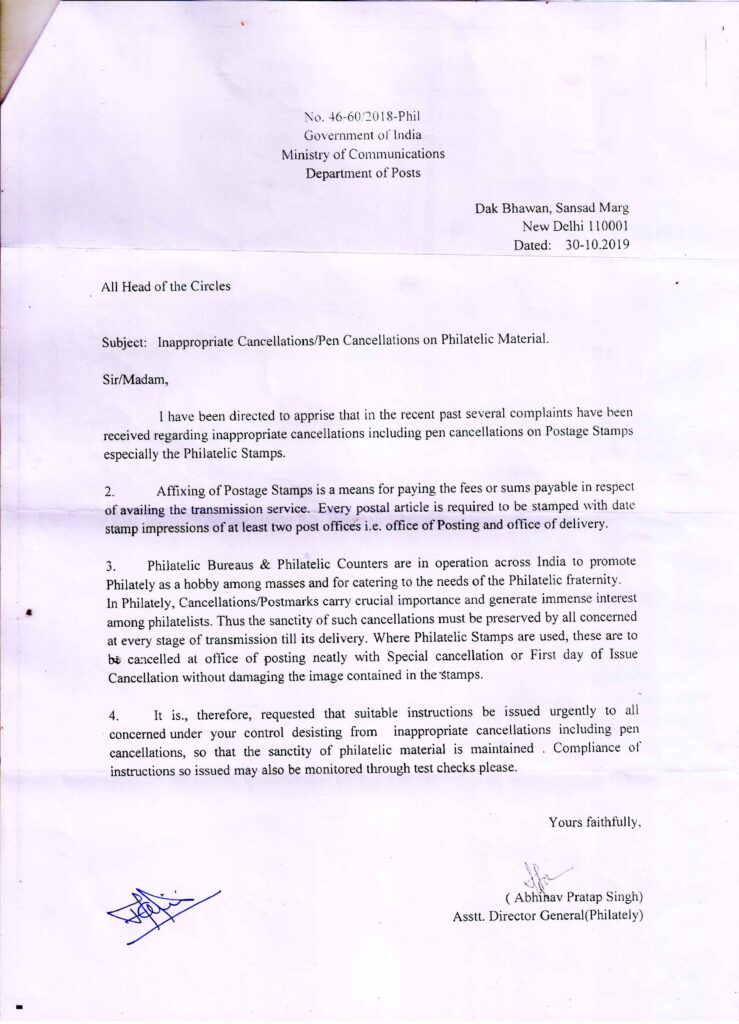
This circular is important.
It clearly shows that the concern is valid. Philatelists are not overreacting. Improper cancellation is a real issue. And India Post has already acknowledged the need to avoid such practices.
The circular also gives collectors a useful reference when they face repeated problems at a post office. Instead of arguing emotionally, one can politely show the circular and explain the matter.
The aim should not be to blame postal staff. Many of them may simply not know how much these cancellations matter to collectors. The better approach is awareness, patience, and proper written communication when needed.
Who Should Take Responsibility?
In most cases, postage stamps are cancelled at the post office from where the article is booked.
That means the sender has an important role.
If we are sending philatelic mail, we should not simply hand over the cover and leave. That is risky. Once the article enters the system without proper cancellation, anything can happen later. It may be pen marked. It may receive a heavy machine cancellation. Or it may get damaged by rough handling.
So, as collectors, we must take responsibility at the booking stage.
A beautiful stamp deserves a proper send-off.
How to Avoid Pen Cancellation on Mail
The first step is simple. After booking the mail, politely request the counter staff to cancel the stamps with a proper round date postmark seal. Do not sound aggressive. Explain that the article is philatelic in nature and that the postmark is important.
In many post offices, cancellation may not be done directly at the counter. It may be done in the despatch section. In such cases, try to meet the despatch in-charge. Explain politely that the stamps should not be marked by pen and should receive a proper date cancellation.
If the staff understand the importance, the problem is usually solved.
But if the issue continues even after repeated requests, then the next step should be formal. Meet the Senior Postmaster. Carry a copy of the circular issued by ADG (Philately) dated 30-10-2019. Submit a written complaint with proof, such as images of pen-cancelled covers.
Do not make the complaint personal. Keep it factual.
Mention the date of booking, post office name, article type, and nature of improper cancellation. Request that staff may be instructed to use proper cancellation devices for postage stamps on mail.
This is more effective than social media anger alone.
Collector’s Note
A pen-cancelled cover is still postal history. It travelled through the postal system. It served its purpose. But for modern commemorative stamps, especially complete sets or special issues, pen cancellation badly affects the visual and collectible appeal.
For collectors, the difference is clear.
A clean round date postmark enhances the cover.
A careless pen mark damages it.
This is why philatelic mail should be handled with extra care. When we use commemorative stamps, miniature sheets, se-tenant pairs, or complete sets on cover, we should also ensure that the cancellation is appropriate.
Otherwise, the effort is wasted.
Closing Notes
The Hyderabad cover reminded me of a larger issue that many collectors face. Pen cancellation may look like a small thing to postal staff, but for philatelists it can ruin the beauty of a carefully prepared mail.
India Post has a rich philatelic tradition. Its stamps celebrate art, culture, history, science, wildlife, festivals, and national achievements. These stamps deserve proper postal treatment when used on mail.
As collectors, we should also do our part.
Request politely. Explain clearly. Carry the circular when needed. And document cases where the problem continues.
A stamp is not only proof of postage.
For us, it is memory, design, history, and emotion packed into a small piece of paper.