

Odisha has a rich postal history. While postage stamps and special covers are widely collected, postal cancellations have received relatively little attention. Many interesting postmarks remain scattered across personal collections, old envelopes and philatelic records.
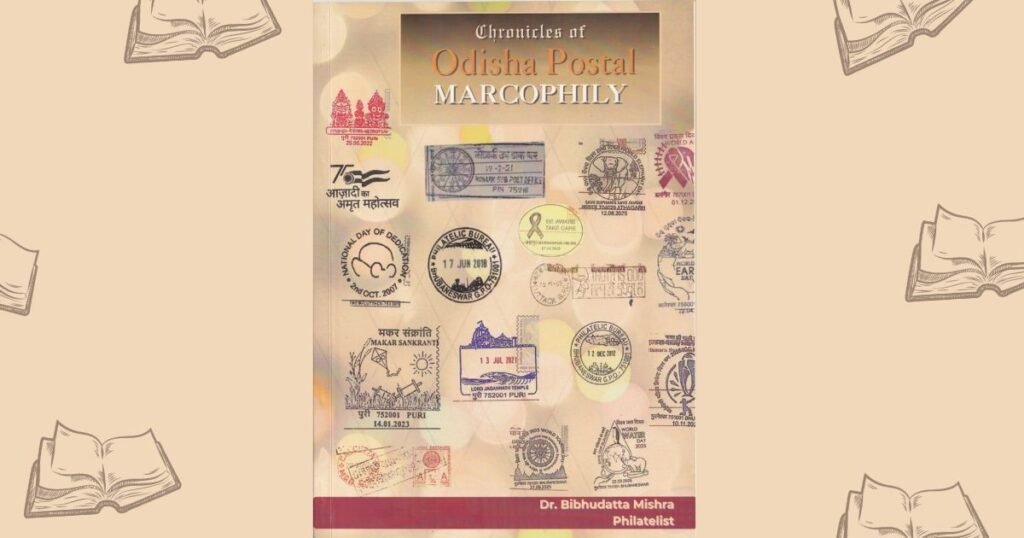
Dr. Bibhudatta Mishra’s Chronicles of Odisha Postal Marcophily is a significant attempt to bring these scattered records together.
For philatelists of Odisha, this publication marks a breakthrough. It is a pioneering effort to document such a wide range of the state’s special postal cancellations in one volume.
About the Book
- Author: Dr. Bibhudatta Mishra
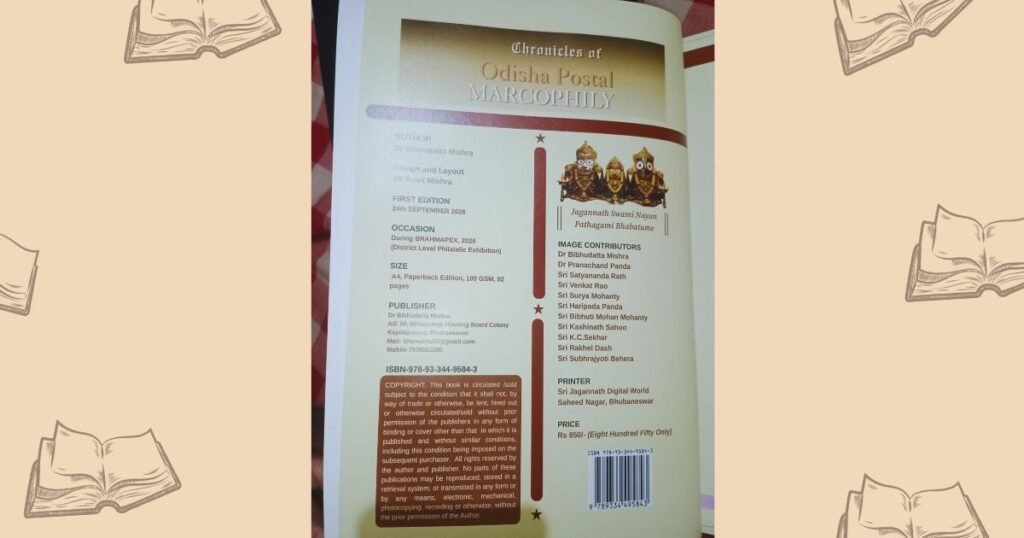
- First Edition: 24 September 2026
- Pages: 92, A4 paperback
- Coverage: Over 500 special cancellations across 18 sections
- Cover Price: ₹850
- Pre-booking Price: ₹650 + shipping
- ISBN: 978-93-344-9584-3
A Special Beginning Despite BRAHMAPEX Postponement
The book was initially scheduled for release during BRAHMAPEX 2026, the philatelic exhibition planned in Berhampur.
However, an advisory from the Ganjam District Administration concerning an approaching cyclone led to the postponement of the exhibition. Schools were ordered closed until 24 September 2026, and fresh exhibition dates were to be announced later.
Rather than delay the publication indefinitely, Dr. Mishra chose a different beginning.
On the auspicious occasion of Bamana Dwadashi, the book was ceremonially inaugurated with its dedication to Lord Jagannath.
It was a meaningful beginning for a publication dedicated to preserving Odisha’s postal heritage.
A Much-Needed Documentation Effort
The greatest strength of this book is its subject.
Odisha has witnessed hundreds of postal cancellations associated with exhibitions, public awareness campaigns, institutions, historical events and cultural occasions. Yet information about these markings has remained scattered and difficult to access.
Dr. Mishra has attempted to address this gap by compiling more than 500 cancellations under 18 categories.
The book covers philatelic bureau cancellations, permanent pictorial cancellations, exhibition cancellations, organisational advertisements, commemorative postmarks and auxiliary postal markings.
One interesting section documents the changing designs of the Cuttack and Bhubaneswar Philatelic Bureau cancellation. Other pages cover early permanent pictorial cancellations from Konark, Khandagiri and Puri.
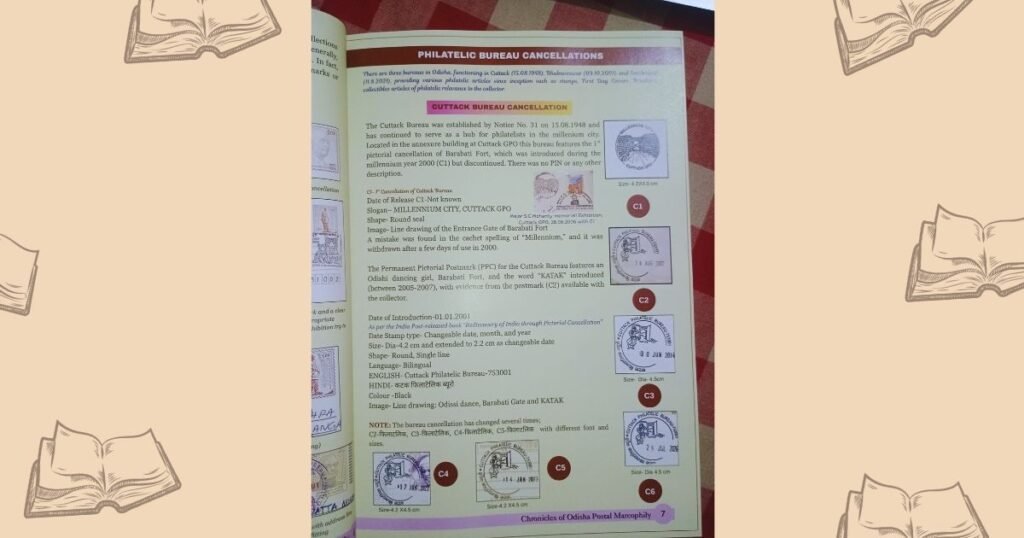
The photographs of marking devices, old impressions and accompanying descriptions add considerable value.
Such documentation is important because physical handstamps may be modified, replaced, damaged or withdrawn. Without proper records, information about their earlier designs may eventually disappear.
Presentation and Collector’s Value
The book follows a straightforward illustrated format. Entries generally include the date, place, shape, dimensions, language, colour and purpose of each cancellation.
This makes it easier for collectors to identify markings and compare different designs.
The illustrations are particularly useful. Instead of presenting only dates and names, the author has reproduced actual cancellation impressions wherever available.
The sections on election awareness, postal advertisements, commemorative events and exhibitions also reveal how postmarks have served purposes beyond cancelling postage stamps.
These examples make the book interesting even for collectors who do not specialise in marcophily.
Scope for Improvement
Compiling such a large collection is not easy, particularly when historical material is scattered across private collections.
There are still areas where future editions could improve.
Some illustrations appear relatively small or faint. Clearer and larger reproductions would make it easier to examine minor differences in lettering, dates and designs.
Supporting references could also strengthen certain entries. Wherever available, postal circulars, departmental notifications or contemporary reports would help establish the history of unusual cancellations.
However, there is an important practical limitation. The Postal Department does not necessarily issue or make available a notification for every cancellation. Many records can only be reconstructed from surviving postal material and information provided by collectors.
Therefore, expecting documentary evidence for every entry would be unrealistic.
The book should be appreciated for what it is: a commendable effort to compile and preserve as many available postal cancellations as possible, providing a valuable starting point for exploring and understanding Odisha’s rich postal history.
A future edition could benefit from additional examples, clearer cancellation impressions and fresh information shared by fellow collectors. These contributions would further enrich this pioneering documentation effort.
Price and Accessibility
The book carries a cover price of ₹850. However, collectors who pre-booked it could purchase a copy for ₹650 plus shipping.
For a 92-page paperback, the regular price may appear somewhat high. But its value cannot be measured by page count alone.
Gathering, identifying, arranging and describing hundreds of postal markings requires considerable effort. For collectors interested in Odisha’s postal history, having these records together offers a practical advantage.
A Personal Note of Thanks
I would like to sincerely thank Dr. Bibhudatta Mishra for acknowledging my small contribution to this publication.
As the author of R D’s Stamp Collection, it is particularly satisfying to see information shared through the blog contributing, even in a small way, to a larger effort to document Odisha’s philatelic heritage.
The book also acknowledges several collectors who contributed images, information and assistance. Such collaboration is essential for preserving material that might otherwise remain inaccessible.
Final Thoughts
Chronicles of Odisha Postal Marcophily is a welcome milestone for Odisha philately.
It may not be a complete or definitive catalogue, and there will certainly be scope for additions. But its greatest achievement is the initiative itself.
For the first time, a substantial effort has been made to bring together such a wide range of Odisha’s special postal cancellations in a dedicated publication.
Dr. Bibhudatta Mishra deserves appreciation for undertaking this challenging compilation.
I hope this publication encourages more collectors to share missing cancellations, better impressions and additional information. Future editions can build upon this effort and create an even more comprehensive record.
For anyone interested in Odisha’s postal history, this book deserves a place on the philatelic bookshelf.
Have you added this book to your collection? Share your thoughts and observations in the comments

