Some philatelic releases commemorate an event. Others become part of the story they celebrate.
The Nalambala Darshanam Pilgrim Carried Special Cover, released by Kerala Postal Circle on 17 July 2026, belongs to the second category. Behind it was a journey across two districts, two postal divisions, four ancient temples and the four post offices serving them.
That journey is what makes this issue interesting.
Nalambala Darshanam is a centuries-old pilgrimage tradition of Kerala, observed during the Malayalam month of Karkkidakam and associated with the reading of the Ramayana. Devotees visit four temples dedicated to Lord Rama and his brothers, traditionally completing the darshan within a single day.
The four sacred stops are Thriprayar Sree Rama Temple, Koodalmanikyam Bharatha Temple at Irinjalakuda, Thirumoozhikkulam Lakshmana Temple and Payammal Shatrughna Temple.
Instead of simply depicting these temples on a commemorative cover, Kerala Postal Circle created something more engaging — a Philatelic Passport around the pilgrimage.
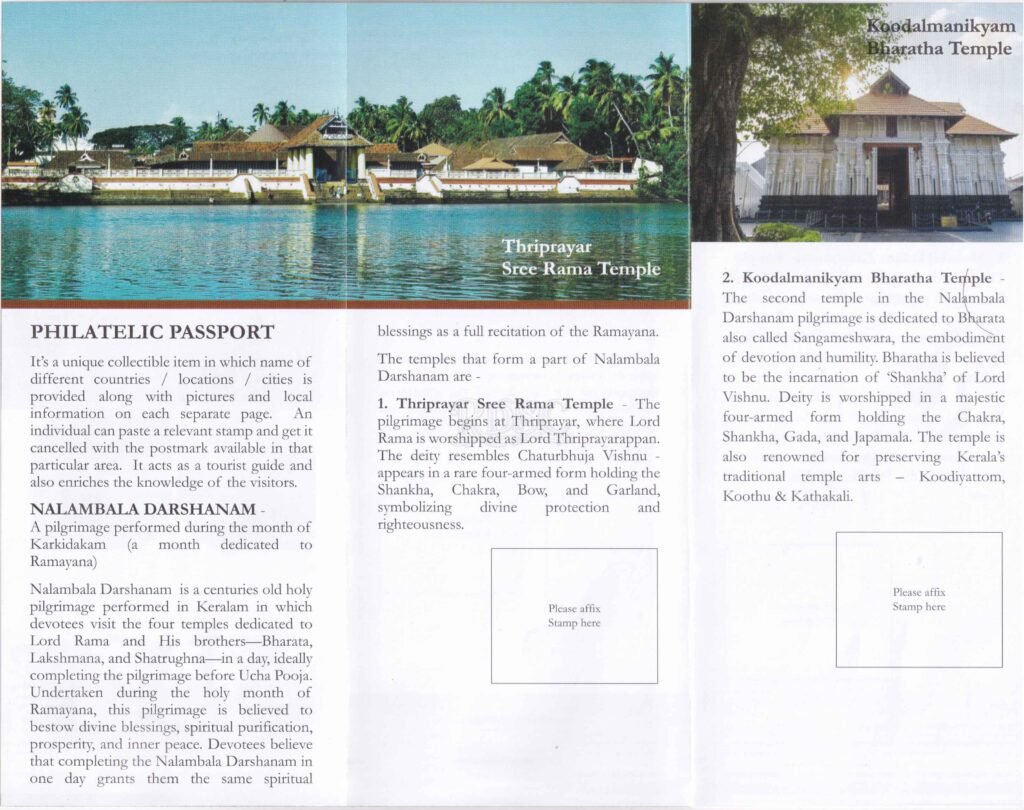
The Philatelic Passport follows the four temples that form the traditional Nalambala Darshanam pilgrimage.
It contains four placeholders for postage stamps, one for each temple. On 17 July 2026, different cancellations were available at the respective locations. A collector or pilgrim could affix a stamp at each stage and obtain four distinct postal impressions while completing the route.
The concept was strong. The execution was not.
All four cancellations were available for only one day.
Anyone wishing to complete the Philatelic Passport therefore had to arrange for all four stamps to be affixed and cancelled at four different locations on 17 July itself. For pilgrims travelling the route, this was possible. For collectors outside the area, or those depending on postal servicing, it became far more difficult.
This is where the Department could have done better.
Once a Philatelic Passport had been designed specifically around four cancellation spaces, Kerala Postal Circle could have arranged for more passports to be officially serviced with all four cancellations. At the very least, collectors should have been given a practical way to obtain a fully completed example.
Whatever the intention, limiting the cancellations to a single day created an avoidable scarcity of fully serviced passports. A philatelic product built around four cancellations should not become difficult to complete simply because the servicing window was so narrow.

Four stamp spaces were provided for the four stages of Nalambala Darshanam.
The Philatelic Passport illustrated here is an unused example. How many passports were actually completed with all four location-specific cancellations is not presently known. Calling them “rare” without official figures would therefore be premature.
What is clear is that fully serviced examples are harder to encounter because the complete set of cancellations could be obtained only on 17 July 2026.
At the centre of the release is the Pilgrim Carried Special Cover itself.
Its artwork traces the Nalambala journey visually. The four temples are marked along a stylised map of Kerala and connected as stages of the pilgrimage. The cover shown here bears two ₹5 Ramayana postage stamps and circular Nalambala Darshanam cancellations dated 17.07.2026.
More importantly, the item is explicitly identified as a “Pilgrim Carried Cover.”
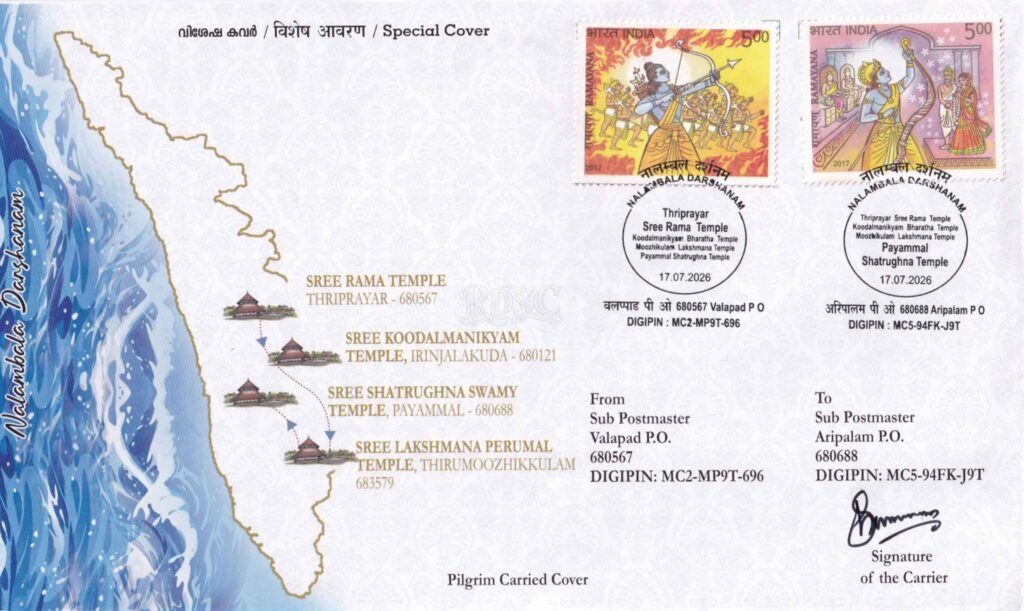
The cover records the pilgrimage through its route, stamps, cancellations and postal endorsements.
The postal markings add another layer to the story. It records movement from the Sub Postmaster, Valapad P.O. – 680567, to the Sub Postmaster, Aripalam P.O. – 680688. It also carries the signature of the carrier.
For carried-mail collectors, that matters.
A carried cover derives much of its significance from movement, route and provenance. The journey becomes part of the object.
Here, pilgrimage and postal history meet naturally.
The accompanying information explains that the issue honours Nalambala Darshanam as practised in Kerala from time immemorial. It was issued by the Chief Postmaster General, Kerala Circle, under reference KL/13/2026, with a listed price of ₹100 excluding stamp charges.
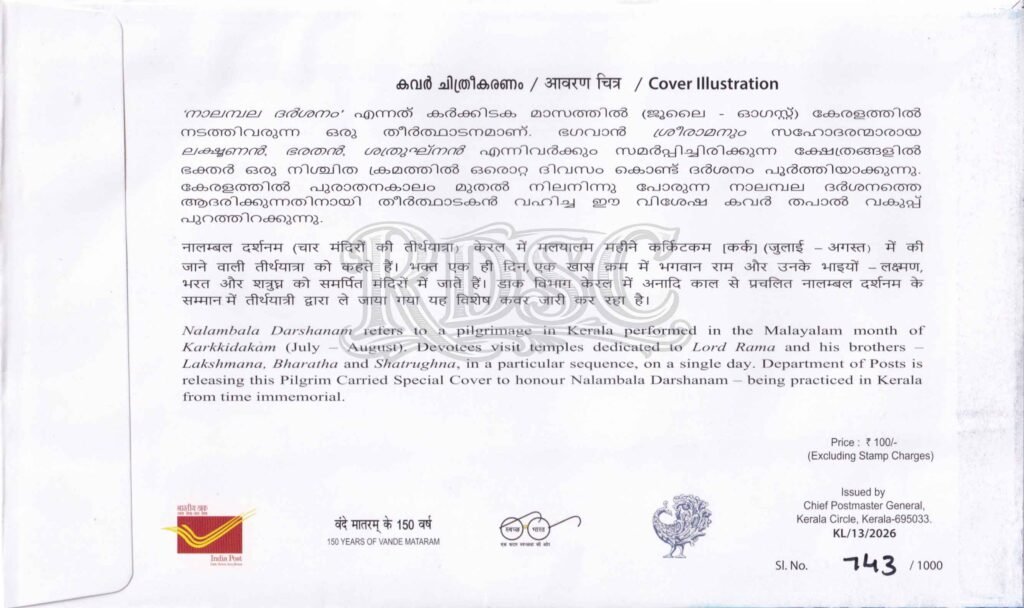
The official information panel explains the purpose behind the Pilgrim Carried Special Cover.
What is easy to miss when looking only at the finished product is the coordination behind it.
This was not simply one post office releasing another special cover. The journey linked four temples and the postal establishments serving them. It crossed district and divisional boundaries. Postal employees had to coordinate the route, handling, cancellations and Philatelic Passport so that each part supported the same story.
That effort deserves recognition.
At the same time, good philatelic design should be matched by good collector access. On that point, the release was less successful.
The passport gives context. The temples provide the cultural narrative. The cancellations establish place and date. The carried cover records movement. The carrier’s signature gives that movement a human connection.
For thematic collectors of Ramayana, temples, pilgrimage, religion or Kerala, the issue has obvious appeal. For carried-mail and modern postal-history collectors, the most interesting combination would be the Pilgrim Carried Special Cover accompanied by a Philatelic Passport bearing all four location-specific cancellations of 17 July 2026.
The difficulty in finding such completed passports adds collector interest. But there is a distinction between genuine scarcity created by historical circumstances and scarcity caused by an unnecessarily restrictive servicing arrangement.
The final cover may occupy only a small space in an album.
The journey behind it crossed temples, post offices, districts and postal divisions.
That journey is what turns this release from another special cover into a piece of contemporary Indian carried-mail history.